|
September 2000
Maxime Old , New Interest In A Midcentury French Master
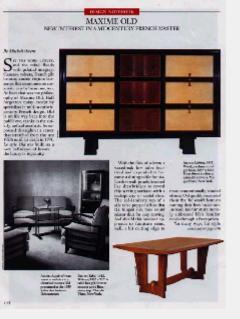
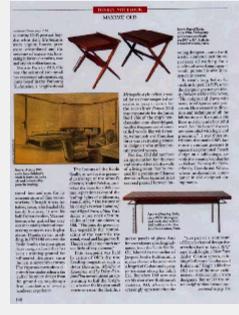
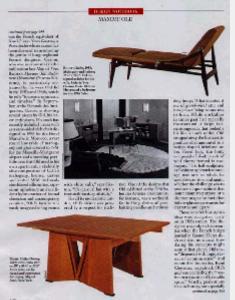
by Mitchell Owens Say the World Luxury,and the mind floods with palatial imagery: Genoese velvets,French gilt bronze,ancien regime boiseries.But commonsense creativity can be luxurious,too.At least that was the philosophy of Maxime Old. Half forgotten today except by specialists in mid-twentieth-century French design,Old is on his way back into the public eye,thanks to the quietly radical aesthetic he espoused throughout a career that stretched from the late 1920s until his death in 1991.Le style Old was built on a new definition of luxury of ingenuity. With the flick of a lever,a waxed-oak low table levitated and expanded to become a dining table for six.Leather wall panels lowered like drawbridges to reveal tidy writing surfaces with a multiplicity of useful slots.The red-laminate top of a side table popped off so that the hinged oak base could scissor shut for easy moving.And should this involved approach to furniture seem,well,a bit cutting edge to more conventionally minded clients,Old quickly reassured them that he wasn't bent on turning their lives inside out.Instead,his furniture merely addressed life's familiar needs through a fresh prism.'In many ways,his stylewas the French equivalent of Knoll,"says Yves Gastou,a Paris dealer whose career has been devoted to promoting the genius of long-neglected French designers.gastou,who was instrumental in the publication last May of Yves Badetz's Maxime Old:Architecte-Decorateur (Norma Editions),is particularly entranced by the work Old did in the 1950s and 1960s,which he calls "futuristic,optimistic and timeless."In September,at the Biennale des Antiquaires,Gastou is showing several pieces by Old,his latest enthusiasm.His stock has recently included pieces such as a cane-sidded club chair designed in 1953 for the Hotel Marhaba in Morocco,a vast round low table of mahogany and glass created in 1961 for the Marseille-marignane airport and a standing portfolio case that Old used in his own apartment,a skeletally chic composition of Cuban mahogany,bronze,canvas and leather.With its broadshouldered silhouettes,capacious upholstery and confident hybridization of formal classicism and contemporary comfort,"Old's furniture is easily imagined in big rooms with white walls," says Gastou.It's classical but with a twentieth-century attitude."For all its modernistic candor,Old's vision was powered by a respect for tradition.One of the designs that Old exhibited at the 1946 Salon des Artstes Decorateurs,for instance,was a worktable for holding skeins of yarn,knitting needles and embroidery hoops.what elevated it out of grand-mere's attic and into jet-set living rooms was its form.while worktables in times past had typically incorporated a large fabric storage sack that looked a bit like a cow's udder,Old stripped away the fustiness to produce what amounted to a wedge-shaped briefcase on low flared legs,the body composed of sleek panels of wild cherry framed in mahogany.This half-sculpture,half-cabinet approach to storage was one to which he would return time and again,whether the challenge was to produce a liquor cabinet that didn't shout its purpose or a discreet magazine rack that hid airtight compartments for cigarettes and cigars. These sensible but stylish ideas were recognized early on in Old's career.The designer was only in his twenties when the French design journalist Gaston Derys declared that no matter how daring his concepts might seem at first glance,Old never"dispensed with logic,reason or common sense." And as another journalist,Rene' chavance,explained,Old's goal was practicality,the "maximum utilization of habitable space."Worthy goals at any time in history,but especially so during Old's postwar heyday,when daily life became more urgent,houses grew more streamlined and the structure of society was loosening in favor of comfort,ease and stylish utilitarism.Born in Paris in 1910,Old was the scion of two small but respected cabinetmaking clans based in the Faubourg St.-Antoine,a neighborhood noted then and now for its concentration of fine woodworkers.though it was his father,Louis,who headed the family business,it was his half-Italian mother,Maximilienne,who pushed her only son into taking their cabinet making concern to a higher plane. Thanks to her prodding,in 1924 Old entered the Ecole Boulle,the prestigious Paris design school that has been a training ground for influential designers since the late nineteenth century.The rigorous curriculum required that students learn the craft of furniture design from the ground up,supplying a firm foundation of sweaty hands-on experience.The lessons of the Ecole Boulle,as well as the personal patronage of the school's director,Andre' Frechet,provided the basis for Old's mature reputation as one of the leading lightsof midcentury French style."The balance of his designs is what I admire," says Miguel saco,a New York dealer whose stock often includes at least one object by Old."The lines,the geometry.but especially the composition of the materials:the metal,wood and lacquerwork.There's neither too much nor too little of any element." This viewpoint was held by critics of Old's day,too.leading magazines such as Art et Decoration,Mobilier et Decoration and Le décor d'Aujourd'hui never missed an opportunity to hail the designer, wheter for his own small apartment near the Bastille,a Metropolis-style office created for an ironmonger industrialist or jazzy interiors for the ocean liner France (Old was responsible for the James Bond chic of the ship's first-class salon-cum-discotheque).And his frequent use of countrified woods like wild cherry,walnut,ash and Canadian birch was a refreshing rebuke to designers who utilized exotic tropical woods. Not that Old did not have an appreciation for the rare and exotic.After all,the walls of a living room that he created for a prominent Chinese dentist in Paris featured dried seaweed pressed between immense panels of glass.And for several years after his graduation from the Ecole Boulle,Old labored in the atelier of Jacques-Emile Ruhlmann,a master ebeniste who never met a length of Cuban Mahogany or macassar ebony he didn't like.But when Old went out on his own after ruhlmann's death in 1933,it became increasingly apparent that the young designer armed with a solid education and the experience of working for a quality-obsessed employer would pursue his own idiosyncratic course. It wasn't long before he made an impact.In 1939,when the designer was not yet thirty ,Mobilier et Decoration wrote,"He designs and draws with taste,intelligence and precision.he oversees the direction and technique of all the fabrications of his studio.He likes and demands beautiful work. And his beautiful woods are assembled with logic and precision." It was those attributes that made Old's furniture a constant presence in spaces that promoted French design on a public stage,notably the country's embassies in Finland,Norway,the Netherlands,Canada and Ghana,whose ambassadors entertained in Old-designed dinning rooms. "He's part of a continuum of French classical design that stretches back to Louis XIV," says Frank Rogin,a New York dealer.Gastou agrees,dubbing Old's work "modernized Ruhlmann."Rogin adds that Old is one of the most architectural of midcentury French designers.But unlike the often weighty blond-wood concoctions of his contemporary Andre' Arbus,which could give the impression of giant blocks of petrified honey, " he created a sense of lightness in his pieces,no matter how monumental they were." Prominent in Old's oeuvre,for example,are large case pieces:armories,buffets and cabinets for liquor,silver and files.Though totemic in shape and frequently planned as the dominant element of a room,they nonetheless have a buoyant quality,due to the designer's tendency to float the slablike elements atop unobtrusive bases,the two structural elements separated by gilt-bronze supports.Chairs,desks and stools often incorporated X-shaped frames that allowed cushions and writing surfaces to seem suspended,weightless,in midair. It was this devotion to simple solutions that kept Maxime old from growing old aesthetically. Decade after decade,he reinvented his artistic vocabulary,honing it to perfection,making it leaner,more sinewy,more in tune with the times.In the 1960s,for istance,when he was busily designing the interiors of banks,offices and ocean liners,the long,tapering leg that he first used in the early 1930s was transmuted into metal and whittled down to stiletto-heel proportions.It showed up again in1987.Just four years before his death,at the age of eighty-one, Old received his last commission,armchairs for the French national archives. High,slender and exquisitely proportioned,the legs and the chairs they supported looked as up-todate as they had a half-century earlier. Details like that keeps Old's furniture from seeming dusty relics,whatever the date of creation.They also explain the steep rise in prices for Old's furniture of late. Custom-made , as was the majority of the designer's output,a wax-finished wildcherry desk that sold for as little as five thousand dollars a decade ago can now command as much as thirty thousand. "He doesn't get trapped in a period,like a lot of Art Deco designers ,such as Ruhlmann,"says Frank rogin."Ruhlmann was the Art Deco ebeniste,but he stays there.Maxime Old took what he learned from Ruhlmann and went further,with very inventive designs that are always in a classical context." |  | 
|